Engine
This article is about a machine to convert energy into useful mechanical motion. For other uses of engine, see Engine (disambiguation). For other uses of motor, see Motor (disambiguation).

Terminology
Originally an engine was a mechanical device that converted force into motion. Military devices such as catapults, trebuchets and battering rams are referred to as siege engines. The term "gin" as in cotton gin is recognised as a short form of the Old French word engin, in turn from the Latin ingenium, related to ingenious. Most devices used in the industrial revolution were referred to as engines, and this is where the steam engine gained its name.[citation needed]In modern usage, the term is used to describe devices capable of performing mechanical work, as in the original steam engine. In most cases the work is produced by exerting a torque or linear force, which is used to operate other machinery which can generate electricity, pump water, or compress gas. In the context of propulsion systems, an air-breathing engine is one that uses atmospheric air to oxidise the fuel carried rather than supplying an independent oxidizer, as in a rocket.
In common usage, an engine burns or otherwise consumes fuel, and is differentiated from an electric machine (i.e., electric motor) that derives power without changing the composition of matter.[3] A heat engine may also serve as a prime mover, a component that transforms the flow or changes in pressure of a fluid into mechanical energy.[4] An automobile powered by an internal combustion engine may make use of various motors and pumps, but ultimately all such devices derive their power from the engine.
The term motor was originally used to distinguish the new internal combustion engine-powered vehicles from earlier vehicles powered by steam engines, such as the steam roller and motor roller, but may be used to refer to any engine.[citation needed]
Devices converting heat energy into motion are commonly referred to simply as engines.[5]
History
Antiquity
Simple machines, such as the club and oar (examples of the lever), are prehistoric. More complex engines using human power, animal power, water power, wind power and even steam power date back to antiquity. Human power was focused by the use of simple engines, such as the capstan, windlass or treadmill, and with ropes, pulleys, and block and tackle arrangements; this power was transmitted usually with the forces multiplied and the speed reduced. These were used in cranes and aboard ships in Ancient Greece, as well as in mines, water pumps and siege engines in Ancient Rome. The writers of those times, including Vitruvius, Frontinus and Pliny the Elder, treat these engines as commonplace, so their invention may be more ancient. By the 1st century AD, cattle and horses were used in mills, driving machines similar to those powered by humans in earlier times.According to Strabo, a water powered mill was built in Kaberia of the kingdom of Mithridates during the 1st century BC. Use of water wheels in mills spread throughout the Roman Empire over the next few centuries. Some were quite complex, with aqueducts, dams, and sluices to maintain and channel the water, along with systems of gears, or toothed-wheels made of wood and metal to regulate the speed of rotation. In a poem by Ausonius in the 4th century AD, he mentions a stone-cutting saw powered by water. Hero of Alexandria is credited with many such wind and steam powered machines in the 1st century AD, including the Aeolipile, but it is not known if any of these were put to practical use.
Medieval
Medieval Muslim engineers employed gears in mills and water-raising machines, and used dams as a source of water power to provide additional power to watermills and water-raising machines. Such advances made it possible for many industrial tasks that were previously driven by manual labour to be mechanized and driven by machinery to some extent in the medieval Islamic world.In 1206, al-Jazari employed a crank-conrod system for two of his water-raising machines. A rudimentary steam turbine device was described by Taqi al-Din in 1551 and by Giovanni Branca in 1629.
In the 13th century, the solid rocket motor was invented in China. Driven by gunpowder, this, the simplest form of internal combustion engine was unable to deliver sustained power, but was useful for propelling weaponry at high speeds towards enemies in battle and for fireworks. After invention, this innovation spread throughout Europe.
Industrial Revolution


As for internal combustion piston engines, these were tested in France in 1807 by de Rivaz and independently, by the Niépce brothers . They were theoretically advanced by Carnot in 1824.[citation needed] The Otto cycle in 1877 was capable of giving a far higher power to weight ratio than steam engines and worked much better for many transportation applications such as cars and aircraft.
Automobiles
The first commercially successful automobile, created by Karl Benz, added to the interest in light and powerful engines. The lightweight petrol internal combustion engine, operating on a four-stroke Otto cycle, has been the most successful for light automobiles, while the more efficient Diesel engine is used for trucks and buses.Horizontally opposed pistons
In 1896, Karl Benz was granted a patent for his design of the first engine with horizontally opposed pistons. His design created an engine in which the corresponding pistons move in horizontal cylinders and reach top dead center simultaneously, thus automatically balancing each other with respect to their individual momentum. Engines of this design are often referred to as flat engines because of their shape and lower profile. They are or were used in: the Volkswagen Beetle, some Porsche and Subaru cars, many BMW and Honda motorcycles, and aircraft engines (for propeller driven aircraft), etc.Advancement
Continuance of the use of the internal combustion engine for automobiles is partly due to the improvement of engine control systems (onboard computers providing engine management processes, and electronically controlled fuel injection). Forced air induction by turbocharging and supercharging have increased power outputs and engine efficiencies. Similar changes have been applied to smaller diesel engines giving them almost the same power characteristics as petrol engines. This is especially evident with the popularity of smaller diesel engine propelled cars in Europe. Larger diesel engines are still often used in trucks and heavy machinery, although they require special machining not available in most factories. They do not burn as clean as gasoline engines, however they have far more torque. The internal combustion engine was originally selected for the automobile due to its flexibility over a wide range of speeds. Also, the power developed for a given weight engine was reasonable; it could be produced by economical mass-production methods; and it used a readily available, moderately priced fuel - petrol.Increasing power
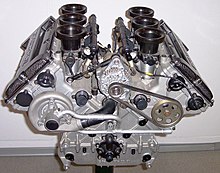
The first half of the 20th century saw a trend to increasing engine power, particularly in the American models. Design changes incorporated all known methods of raising engine capacity, including increasing the pressure in the cylinders to improve efficiency, increasing the size of the engine, and increasing the speed at which power is generated. The higher forces and pressures created by these changes created engine vibration and size problems that led to stiffer, more compact engines with V and opposed cylinder layouts replacing longer straight-line arrangements.Combustion efficiency
The design principles favoured in Europe, because of economic and other restraints such as smaller and twistier roads, leant toward smaller cars and corresponding to the design principles that concentrated on increasing the combustion efficiency of smaller engines. This produced more economical engines with earlier four-cylinder designs rated at 40 horsepower (30 kW) and six-cylinder designs rated as low as 80 horsepower (60 kW), compared with the large volume V-8 American engines with power ratings in the range from 250 to 350 hp (190 to 260 kW).Engine configuration
Earlier automobile engine development produced a much larger range of engines than is in common use today. Engines have ranged from 1- to 16-cylinder designs with corresponding differences in overall size, weight, piston displacement, and cylinder bores. Four cylinders and power ratings from 19 to 120 hp (14 to 90 kW) were followed in a majority of the models. Several three-cylinder, two-stroke-cycle models were built while most engines had straight or in-line cylinders. There were several V-type models and horizontally opposed two- and four-cylinder makes too. Overhead camshafts were frequently employed. The smaller engines were commonly air-cooled and located at the rear of the vehicle; compression ratios were relatively low. The 1970s and '80s saw an increased interest in improved fuel economy which brought in a return to smaller V-6 and four-cylinder layouts, with as many as five valves per cylinder to improve efficiency. The Bugatti Veyron 16.4 operates with a W16 engine meaning that two V8 cylinder layouts are positioned next to each other to create the W shape sharing the same crankshaft.The largest internal combustion engine ever built is the Wärtsilä-Sulzer RTA96-C, a 14-cylinder, 2-stroke turbocharged diesel engine that was designed to power the Emma Maersk, the largest container ship in the world. This engine weighs 2300 tons, and when running at 102 RPM produces 109,000 bhp (80,080 kW) consuming some 13.7 tons of fuel each hour.

No comments:
Post a Comment